
Dispatch: Taiwan - February 18–24, 2026
Dispatch: Taiwan | Forward Horizon Group | February 2026

Strategic Assessment
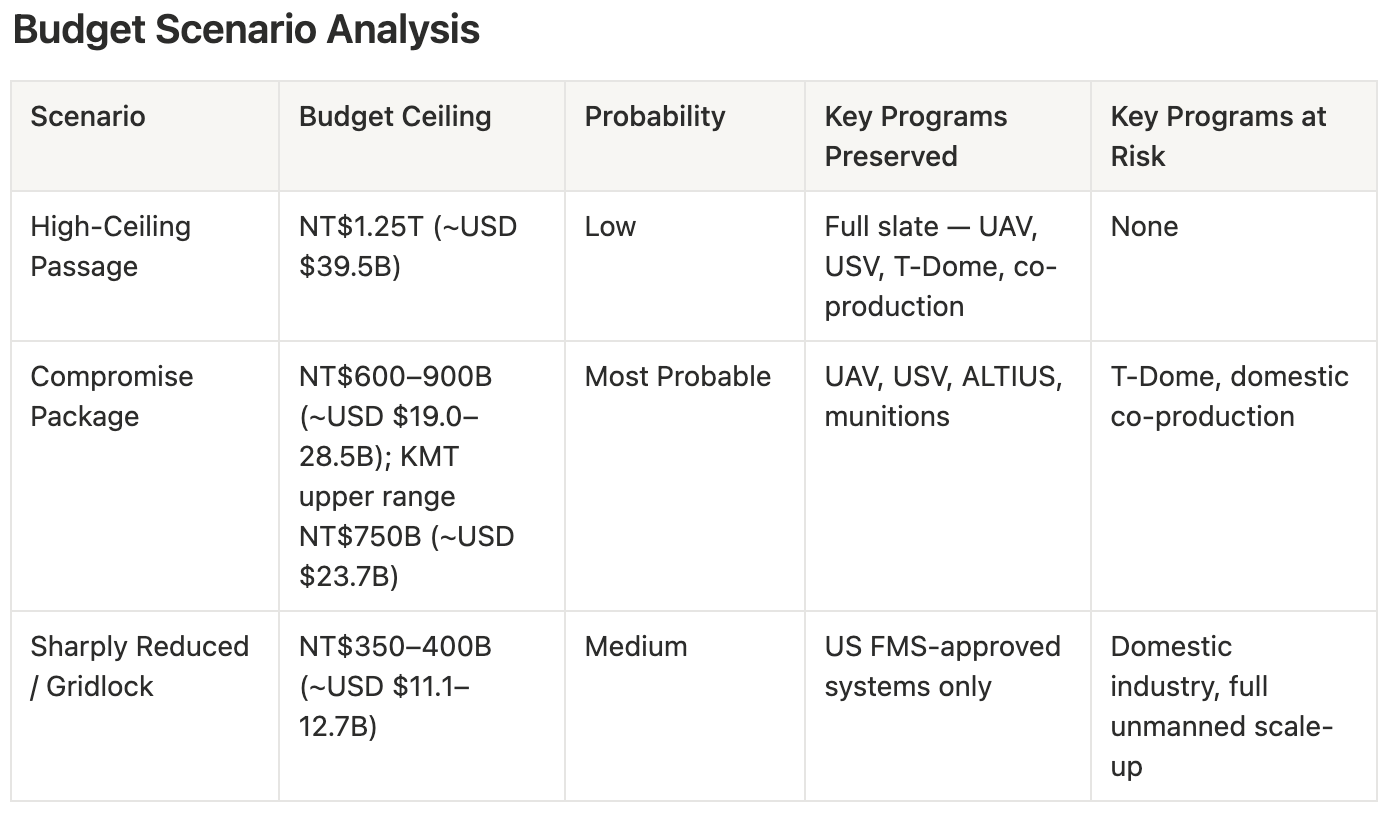
Three developments define this dispatch window. Taiwan’s new legislative session opened February 24 with the NT$1.25 trillion (~USD $39.5B) special defense budget as the stated top priority — but KMT internal cap discussions ranging from NT$350B–$750B (~USD $11.1–23.7B) and a hard March 15 LOA expiration deadline on existing FMS cases mean the negotiation window is shorter and the stakes are higher than the headlines suggest. Concurrent with that fight, President Trump confirmed on February 18 that he is discussing Taiwan arms sales with Xi Jinping — a signal that new FMS notifications may be on hold and that the bilateral arms pipeline faces near-term political headwinds independent of Taipei’s domestic political stalemate. For defense technology companies, the procurement signals are hardening while the delivery infrastructure is softening.
Cross-Strait Security Environment
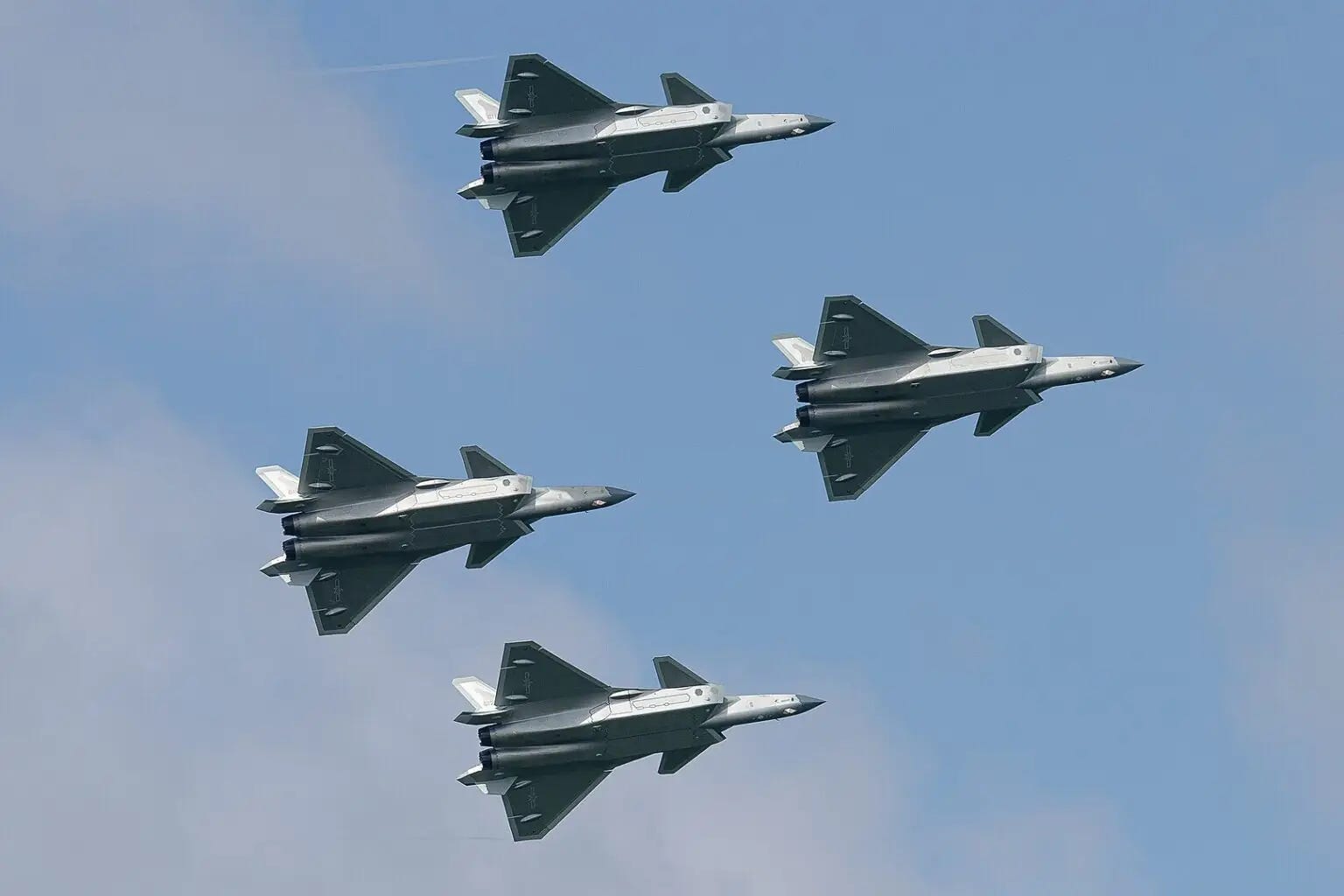
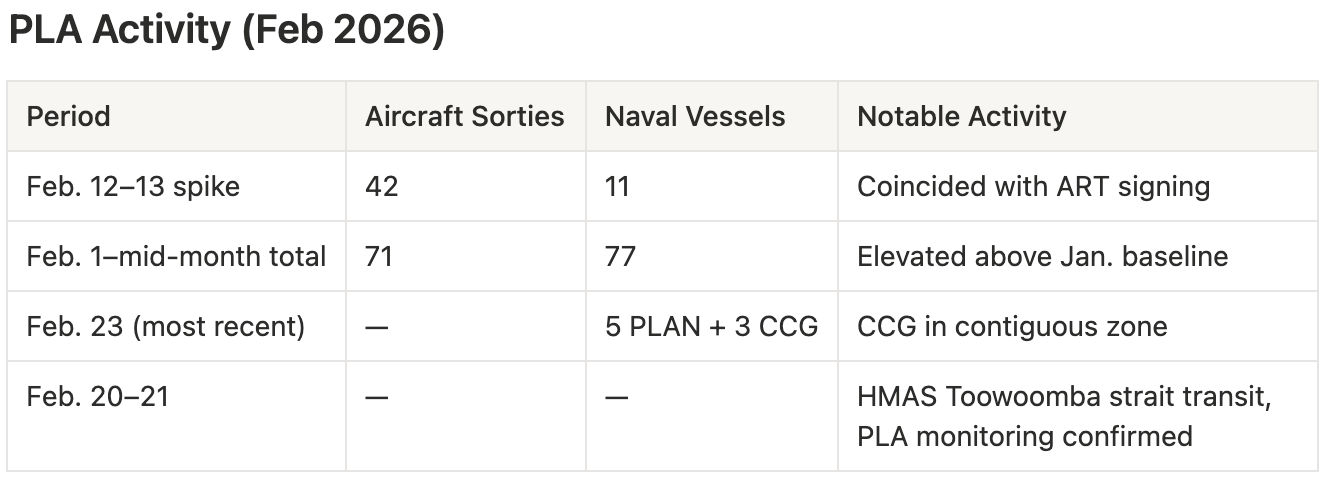
PLA pressure through February has been measurable and documented. Taiwan’s MND tracked 71 aircraft sorties and 77 naval vessels through mid-February, with a notable spike on February 12–13 — 42 aircraft sorties and 11 naval vessels detected in a concentrated activity window that coincided with the ART signing. As of February 23: 5 PLAN vessels and 3 Chinese coast guard ships operating in proximity to Taiwan. MND continues to report daily coast guard incursions within the contiguous zone, with Chinese official ships establishing persistent presence in the 12-nautical-mile buffer as standard operating procedure rather than escalatory signaling [HIGH confidence — MND daily release data].
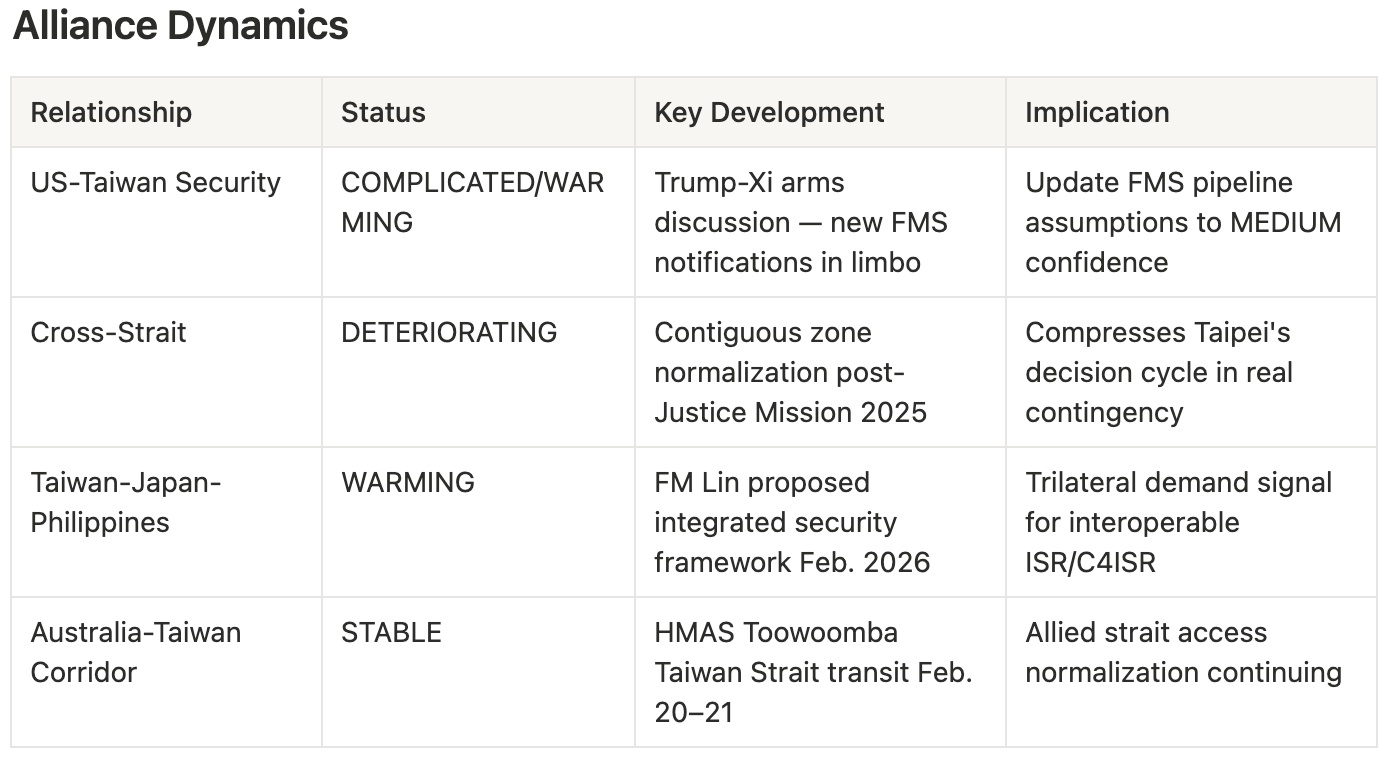
The Australian frigate HMAS Toowoomba transited the Taiwan Strait on February 20–21 under close PLA monitoring — a freedom of navigation operation worth noting as allied navies continue to normalize Taiwan Strait transits against rising PLA pressure.
The structural shift that defines the current environment: PLA and coast guard presence near Taiwan’s contiguous zone is no longer episodic. It is operationally persistent. That compression of warning time is the direct driver behind Taiwan’s procurement urgency for distributed detection, rapid classification, and C4ISR resilience — and it is the environment in which FHG clients should frame any capability pitched into the Taiwan defense corridor.
Xi Jinping’s anti-corruption and loyalty purges have reached senior PLA and defense industry leadership, consolidating personal CMC authority and reducing the collective decision-making checks that previously characterized PLA command. [MEDIUM confidence] Whether that consolidation increases or simply makes less predictable the risk of escalatory action remains analytically open.
Defense Modernization & Procurement
The budget fight hardened this week. The fifth session of the 11th Legislative Yuan opened February 24 with the special defense budget formally first on the agenda. Three competing positions define the negotiation:
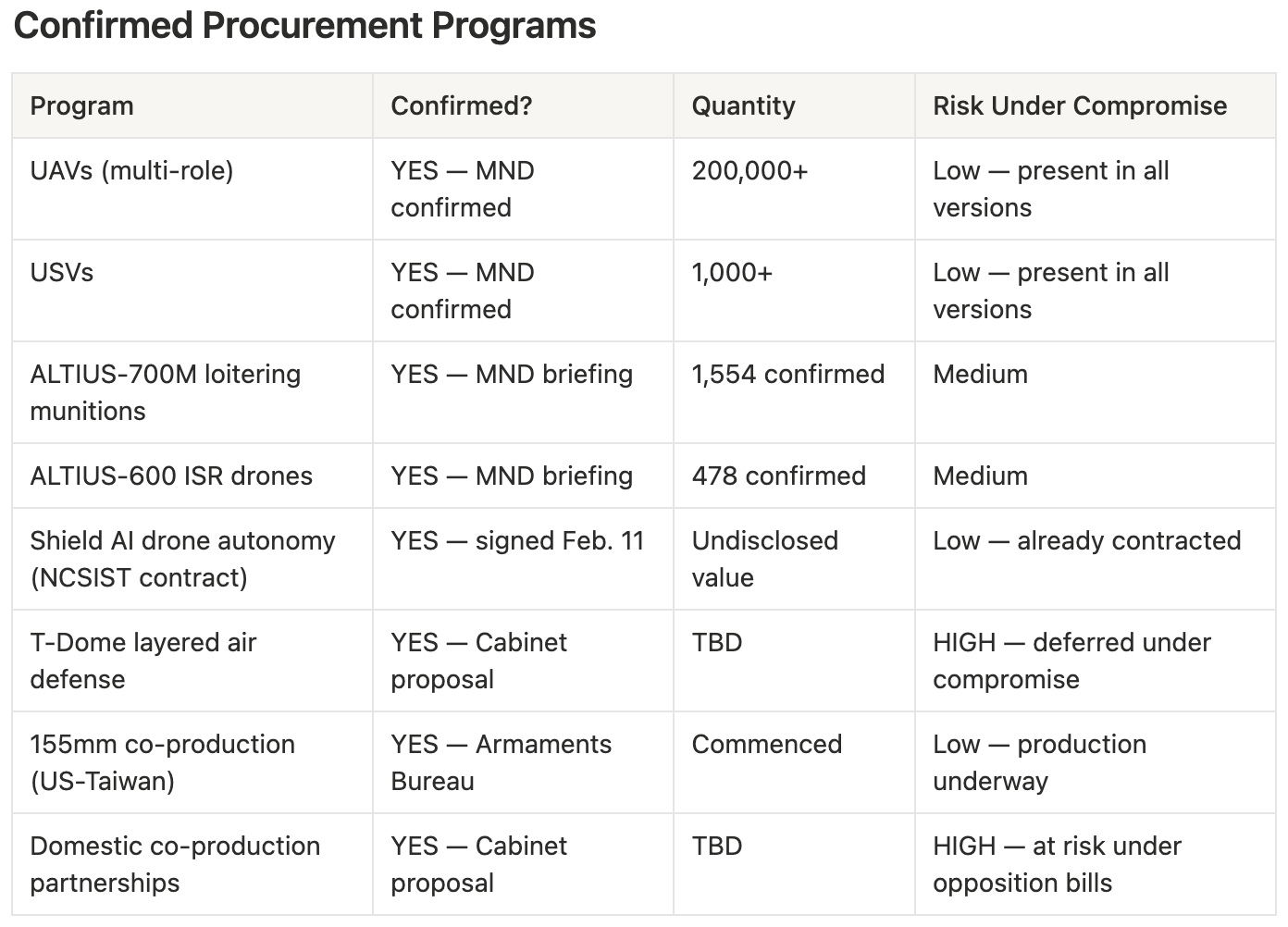
The DPP/Cabinet holds at NT$1.25 trillion (~USD $39.5B, 2026–2033), with NT$950B (~USD $30.1B, roughly 75% of total) allocated to US-origin FMS and co-development programs. Full procurement slate includes 200,000+ UAVs, 1,000+ USVs, T-Dome layered air defense, C5ISR joint development, domestic industry partnerships, and a confirmed precision munitions portfolio.
The TPP counter-bill caps at NT$400B (~USD $12.7B) through 2033, covers only five of eight US-approved systems, requires annual rather than committed multi-year funding, and excludes T-Dome, the full UAV/USV programs, and domestic co-production lines.
The KMT has not tabled a formal bill but internal caucus discussions indicate a ceiling range of NT$350B–$750B (~USD $11.1–23.7B) — a span wide enough to accommodate either a minimalist blocking position or a genuine compromise with the DPP at a mid-range figure. The upper end of that range would preserve core unmanned programs while deferring integrated air defense and major co-production. The lower end is functionally equivalent to the TPP’s bill.
The March 15 hard deadline — LOA expiration on existing FMS cases — adds urgency that wasn’t visible in earlier reporting. Several previously approved US arms packages require movement by that date or Taiwan loses the purchase authorization. Whether that deadline accelerates legislative action or becomes a source of additional US pressure on the KMT is the immediate analytical question.
US pressure is sustained and bipartisan. 37 lawmakers wrote directly to Speaker Han warning of LOA expiration. Senate Foreign Relations chairs Risch and Shaheen called the stalled budget "deeply disappointing." Senate Armed Services Chair Wicker publicly criticized the opposition for cutting the bill "dramatically." The Trump administration has publicly welcomed Taiwan's 3.3% GDP regular defense target and the 5% aspiration, though the Trump-Xi arms discussion complicates the bilateral picture.
Technology & Industrial Base

The most concrete procurement action in February: Shield AI signed a contract with NCSIST on February 11 for AI-driven drone autonomy integration — a named vendor, confirmed deal, and the clearest signal yet that Taiwan’s drone industrial strategy is advancing at the prime contractor level regardless of the special budget’s legislative status.
The confirmed ALTIUS quantities now anchor what was previously estimate territory: 1,554 ALTIUS-700M loitering munitions and 478 ALTIUS-600 ISR drones are in the procurement plan, drawn from MND briefing materials. These are US-origin systems from the Shield AI / Area-I portfolio and represent confirmed addressable market for companies in the autonomous systems stack with NCSIST integration pathways.
The 155mm artillery co-production arrangement has commenced, per Armaments Bureau confirmation — past the planning phase and into production. Ukraine-derived consumption-rate assumptions are the planning baseline. This is an active manufacturing ramp, not a future program.
Formosat-8A is performing better than expected per TASA’s February 16 release — first high-resolution imagery of Hsinchu Science Park confirmed, with the satellite’s 0.7m-resolution capability validated in operational conditions. First of eight in the planned constellation. The LEO communications resilience program targeting DDIL-hardened architecture remains in planning, with timeline contingent on budget resolution.
Taiwan confirmed its 2026 regular defense budget at 3.3% of GDP (~USD $31B) — the first time that target has been formally confirmed rather than aspirationally cited. The special budget, if passed, supplements that baseline rather than replacing it.
Regional & Alliance Dynamics
The Trump-Xi arms discussion is the most consequential new development for defense technology companies. Trump confirmed on February 18 that he is in discussions with Xi Jinping about Taiwan arms sales. A WSJ report on February 20 characterized new FMS notifications as “in limbo” pending the outcome of those discussions. No new DSCA notifications were issued in February. The existing USD $11.1B arms package approved in late 2025 remains the active baseline, but companies planning market entry on the assumption of near-term additional FMS approvals should update that planning assumption to MEDIUM confidence until further notice.
The Agreement on Reciprocal Trade (signed Feb. 12) and companion investment MOU anchor the bilateral economic-security architecture regardless of the arms discussion. Legislature review of the ART begins March 12 — adding a third high-stakes legislative approval timeline running in parallel with the defense budget fight and giving the KMT and TPP another procedural pressure point. Core ART structure: unified 15% tariff framework on Taiwanese goods entering the US; up to USD $500B in Taiwanese investment commitments in US semiconductors, AI, and energy; explicit defense technology and advanced manufacturing cooperation provisions.
Foreign Minister Lin Chia-lung proposed a Taiwan-Japan-Philippines integrated security framework in February — a notable diplomatic initiative at a moment when all three face direct PLA pressure. The 12th US-Philippines Bilateral Strategic Dialogue (Feb. 16) separately reaffirmed Taiwan Strait peace and stability as a core interest. The HMAS Toowoomba Taiwan Strait transit on February 20–21 represents Australia’s continued operational contribution to strait access normalization.
Forward Outlook
The next three weeks are the decisive window. The legislative session opened February 24. The March 15 LOA expiration on existing FMS cases creates a hard deadline that may force a compromise earlier than the opposition would prefer — or may simply result in lost purchase authorizations if the gridlock holds.
For planning: the Shield AI-NCSIST contract, confirmed ALTIUS quantities, and 155mm co-production commencement demonstrate that procurement activity at the contracted level is proceeding independent of the special budget's legislative fate. Companies in the autonomous systems stack, counter-UAS, DDIL-resilient architecture, and production-scaling should be building NCSIST and Armaments Bureau relationships in 2026. Once a political window opens, procurement timelines compress. Vendors without established relationships don't recover that lead time.
Forward Horizon Group deploys dual-use technologies in contested environments and delivers the proof points that unlock procurement and investment. Reach out to us directly at strategy@forwardhorizon.io
Glossary of Acronyms
ADIZ — Air Defense Identification Zone. Taiwan’s self-declared airspace buffer extending beyond its territorial airspace; PLA incursions into this zone are tracked and reported daily by Taiwan’s MND.
AIT — American Institute in Taiwan. The de facto US embassy in Taipei, operating under the Taiwan Relations Act in the absence of formal diplomatic relations.
ALTIUS — Tube-launched unmanned aerial system family developed by Area-I (now part of Shield AI). ALTIUS-700M is a loitering munition variant; ALTIUS-600 is an ISR platform.
ART — Agreement on Reciprocal Trade. The US-Taiwan bilateral trade agreement signed February 12, 2026, establishing a unified 15% tariff framework and investment commitments.
Armaments Bureau — Taiwan’s primary defense procurement and weapons development agency, subordinate to the Ministry of National Defense.
CCG — Chinese Coast Guard. Beijing’s maritime law enforcement force, increasingly used as a gray-zone coercion instrument in Taiwan’s contiguous zone.
C4ISR — Command, Control, Communications, Computers, Intelligence, Surveillance, and Reconnaissance.
C5ISR — Command, Control, Communications, Computers, Cyber, Intelligence, Surveillance, and Reconnaissance. The expanded formulation used by Taiwan’s MND in special budget briefings.
CMC — Central Military Commission. China’s supreme military command authority, chaired by Xi Jinping.
CNA — Central News Agency. Taiwan’s state-run national news agency; primary wire service for government and legislative reporting.
DDIL — Denied, Disrupted, Intermittent, and Limited. Describes communications and operational environments under electronic warfare pressure — the baseline planning condition for Taiwan Strait contingencies.
DPP — Democratic Progressive Party. Taiwan’s ruling party, led by President Lai Ching-te.
DSCA — Defense Security Cooperation Agency. The US agency that administers Foreign Military Sales notifications and approvals.
EW — Electronic Warfare. The use of the electromagnetic spectrum to attack, deceive, or deny adversary systems — a defining feature of both the Ukraine conflict and Taiwan Strait contingency planning.
FMS — Foreign Military Sales. The US government-to-government arms transfer mechanism through which Taiwan acquires most US-origin defense systems.
FHG — Forward Horizon Group. The publisher of this dispatch.
ISR — Intelligence, Surveillance, and Reconnaissance.
KMT — Kuomintang (Chinese Nationalist Party). Taiwan’s main opposition party, currently holding a legislative majority in coalition with the TPP.
LEO — Low Earth Orbit. Satellite constellation altitude band (roughly 200–2,000km) used by commercial systems including Starlink; Taiwan is developing a domestic LEO communications constellation for DDIL resilience.
LOA — Letter of Offer and Acceptance. The formal US government document initiating an FMS case; LOAs have expiration deadlines by which Taiwan must act or lose the purchase authorization.
MND — Ministry of National Defense. Taiwan’s primary defense ministry, responsible for daily PLA activity reporting and oversight of the Armaments Bureau and NCSIST.
MOU — Memorandum of Understanding.
NCSIST — National Chung-Shan Institute of Science and Technology. Taiwan’s primary defense research and development organization, responsible for indigenous weapons programs including the T-Dome air defense system and domestic UAV development.
NT$ — New Taiwan Dollar. Exchange rate used in this dispatch: approximately NT$31.6 = USD $1.00, consistent with CNA/Focus Taiwan sourcing from February 2026.
PDA — Presidential Drawdown Authority. US authority to transfer defense articles directly from DoD stocks to Taiwan without a standard FMS process.
PLA — People’s Liberation Army. China’s armed forces.
PLAN — People’s Liberation Army Navy.
TASA — Taiwan Space Agency. Taiwan’s national space agency, managing the Formosat satellite constellation program.
T-Dome — Taiwan’s domestically developed multilayered air defense system, designed and produced by NCSIST. One of the highest-risk line items under a legislative compromise scenario.
TPP — Taiwan People’s Party. Smaller opposition party in Taiwan’s legislature; tabled a NT$400B (~USD $12.7B) counter-bill to the Cabinet’s special defense budget.
USTR — United States Trade Representative. US agency that negotiated the ART with Taiwan.
UAV / UAS — Unmanned Aerial Vehicle / Unmanned Aerial System. Used interchangeably in this dispatch; UAS is the more precise term encompassing the full system (vehicle, ground control, communications).
USV — Unmanned Surface Vessel. Autonomous or remotely operated maritime platform; Taiwan’s special budget targets 1,000+ USVs for coastal defense, distributed sensing, and autonomous maritime operations.
Exchange rate note: All NT$ to USD conversions in this dispatch use a rate of approximately NT$31.6 = USD $1.00, consistent with CNA and Focus Taiwan sourcing from February 2026. Figures labeled “~USD” are approximate.