Dispatch: Ukraine — February 19–March 9, 2026
Dispatch: Ukraine | Forward Horizon Group | March 10, 2026
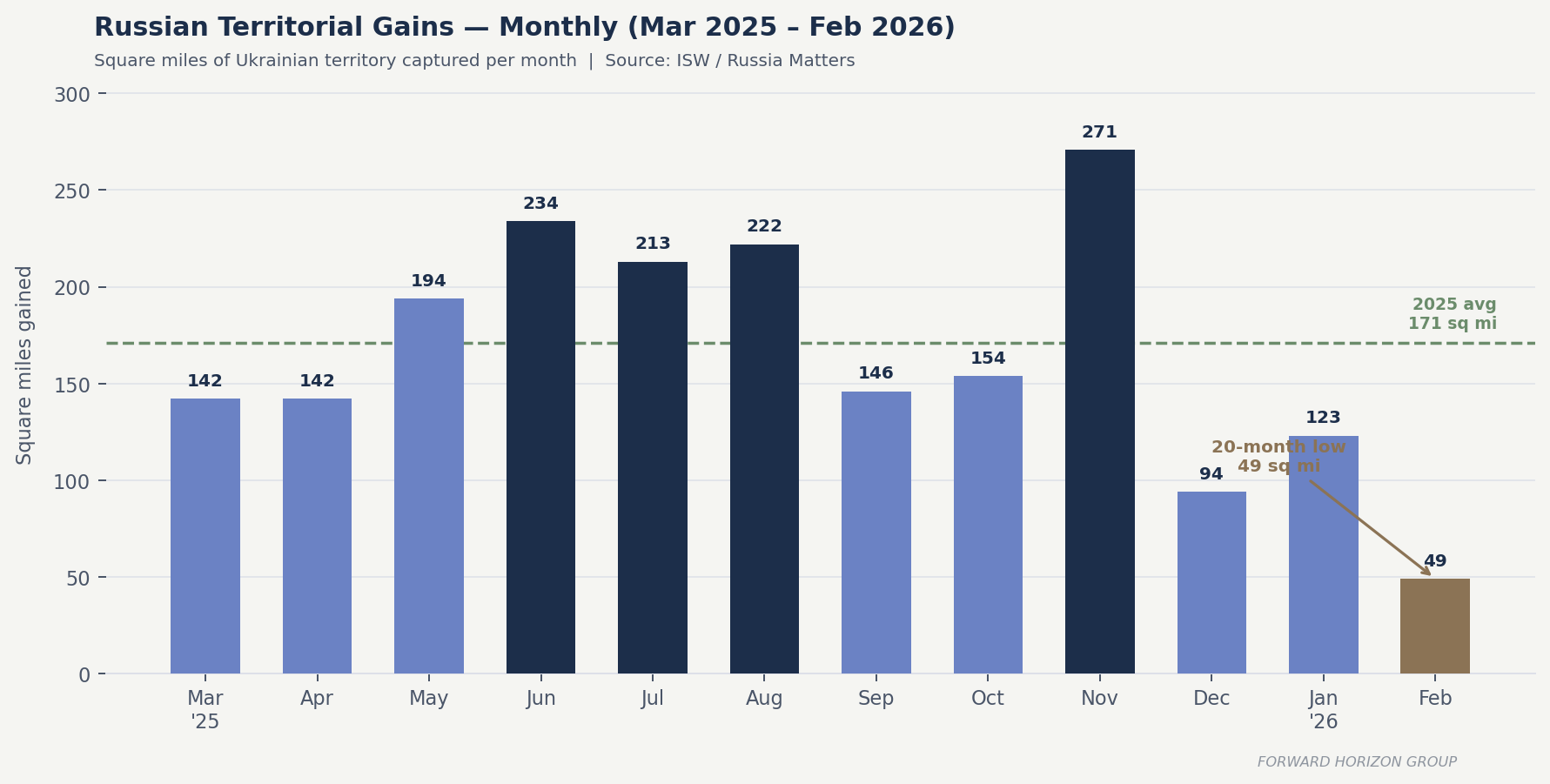
Strategic Assessment: Russia’s February territorial gains hit a 20-month low — 49 square miles, down from 123 in January — as Ukraine’s southern counteroffensive forced the redeployment of Russian elite VDV units away from the Pokrovsk axis, potentially disrupting Moscow’s spring offensive sequencing. Russia’s response to slipping battlefield momentum was escalatory: a March 7 strike on Kharkiv killed 10 civilians including two children using a newly identified cruise missile type, while a higher-than-normal ballistic missile ratio in recent strike packages signals Russia is deliberately probing Ukraine’s depleted Patriot interceptor stocks. Geneva talks remain scheduled but unresolved, and the diplomatic picture is now being shaped as much by the Iran war and US attention fragmentation as by anything said at the negotiating table.
Battlefield Situation
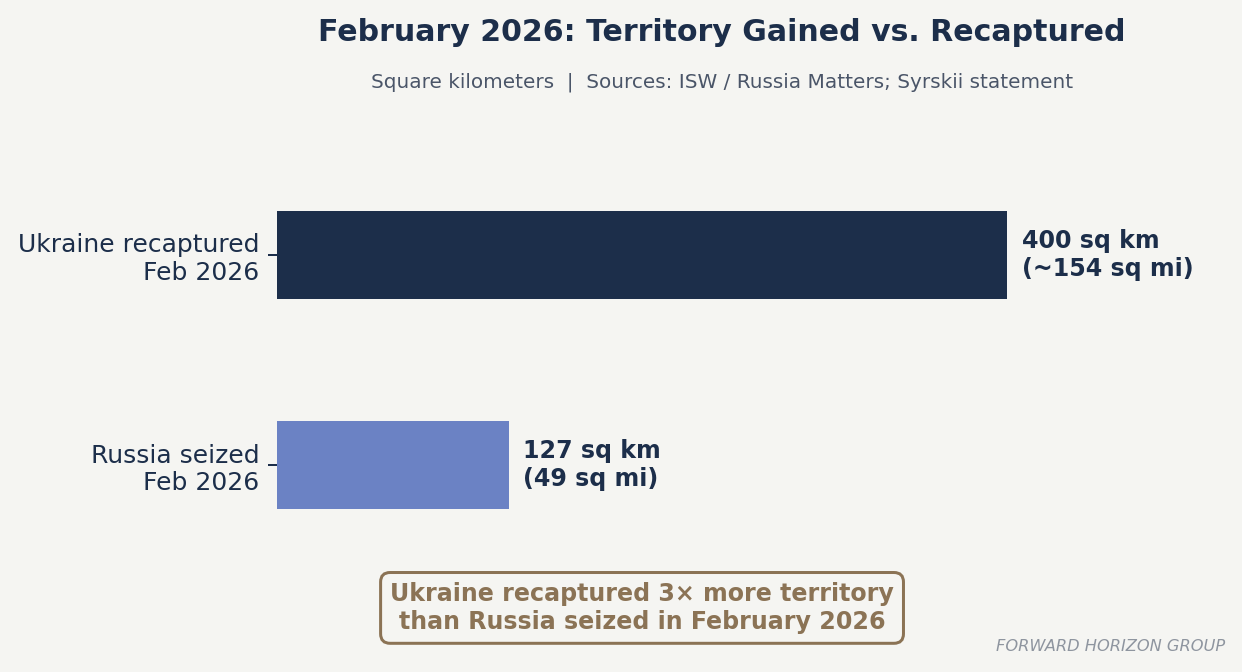
Ukraine’s February counteroffensive in the Zaporizhzhia-Dnipropetrovsk junction produced the most consequential operational result since Kherson: ISW assessed that Ukrainian forces liberated more territory in the final two weeks of February than Russia seized during the same period. Russia’s total February gains — 49 square miles — were the smallest monthly advance since July 2024, less than half of January’s pace. Zelensky and commander-in-chief Syrskii confirmed 300–400 square kilometers recaptured in the south since late January. [HIGH confidence — ISW data, DeepState corroboration]
The operational logic behind Ukraine’s gains is now clearer. The counterattack targeted the northern flank of Russia’s “Vostok” contingent, which had advanced far west of Huliaipole in a thin chain of strongpoints along the Vovcha River rather than a continuous defensive line. Ukrainian forces held bridgeheads on the Vovcha’s southern bank and, reinforced with fresh assault regiments and air assault brigades, advanced southward to cut off the overextended Russian salient. The Russian military command laterally redeployed elite VDV and naval infantry units from the Pokrovsk direction to the southern front in response. ISW assessed that Ukraine’s February counterattacks may have generated spoiling effects against Russia’s anticipated spring-summer offensive, which had been building toward the Huliaipole direction.
Russia has not stood down. The March 6–7 Russian strike series contained a notably higher proportion of ballistic missiles than Russia typically includes in regular strike packages. ISW assessed that Russia is likely trying to exploit Ukraine’s shortage of Patriot interceptors and take advantage of the ongoing conflict in the Middle East. On the ground, Russia has been increasingly disrupting Ukraine’s railway logistics through targeted strikes since July 2025, and Ukrainian reporting indicates that Russian forces are only intensifying this effort going into spring 2026. The Zaporizhzhia sector alone absorbed 21 airstrikes, 241 artillery strikes, and 358 micro-drone engagements in a single day on March 7.
Strike Operations: Both Directions
Russia’s escalation. On the night of March 6–7, Russia launched 29 missiles and 480 drones across Ukraine, targeting energy facilities in Kyiv and other central regions. Ukrainian air defenses downed 453 drones and 19 missiles, but nine missiles and 26 attack drones hit 22 sites. In Kharkiv, a Russian ballistic missile struck a five-story residential building, killing at least 10 people including two children. The attack brought down an entire entrance section from the first floor to the fifth. The Kharkiv Regional Prosecutor’s Office opened a war crimes investigation, with preliminary findings indicating Russia deployed the Izdeliye-30 cruise missile in the strike. Ukraine’s air defense neutralized 161 of 197 drones on the March 8 overnight follow-on attack.
The Kharkiv strikes carry a deliberate signal beyond tactical effect. Russia is systematically targeting Ukraine’s second-largest city at a moment when Patriot stockpiles across European NATO members are under pressure from the Middle East campaign. The intercept capability gap is real and widening.

Ukraine’s deep strike campaign. On the night of March 3–4, Ukrainian forces struck a Russian Admiral Grigorovich-class frigate in the port of Novorossiysk and a chemical plant in Kirovo-Chepetsk in Kirov Oblast, approximately 900 kilometers east of Moscow. On March 7, Ukrainian forces conducted an ATACMS/SCALP-EG missile strike against a Russian Shahed drone launch site near occupied Donetsk City. A Russian official said fragments recovered at the scene indicated that Ukrainian forces had used a previously unseen fixed-wing strike drone, believed to be known as the Hornet. Ukraine has not formally acknowledged the system.
The Votkinsk factory strike (Flamingo cruise missiles, February 21) — confirmed damage to workshops producing Iskander, Oreshnik, and Yars systems at 1,230 kilometers range — remains the strategic centerpiece of the period. Together with the January Kapustin Yar and March Kirovo-Chepetsk strikes, Ukraine has now executed a sequential campaign against Russia’s missile industrial base at ranges exceeding anything achieved in the war’s first three years.
Technology & Threat Evolution
Russia’s Geran-5: the drone threat expands. Russia deployed a new jet-powered drone, the Geran-5, against Ukraine for the first time in early 2026. The drone is approximately 6 meters long with a 5.5-meter wingspan, carries a 90-kilogram warhead, and has a claimed strike range of approximately 1,000 kilometers. Unlike earlier Geran variants derived from Iran’s Shahed airframe, the Geran-5 bears significant design similarities to Iran’s Karrar drone and is powered by a Chinese-made Telefly jet engine. Russian forces are exploring air-launching the Geran-5 from Su-25 attack aircraft to extend effective range, and are evaluating fitting the platform with R-73 air-to-air missiles — a configuration that would turn the drone into a platform capable of engaging air targets.
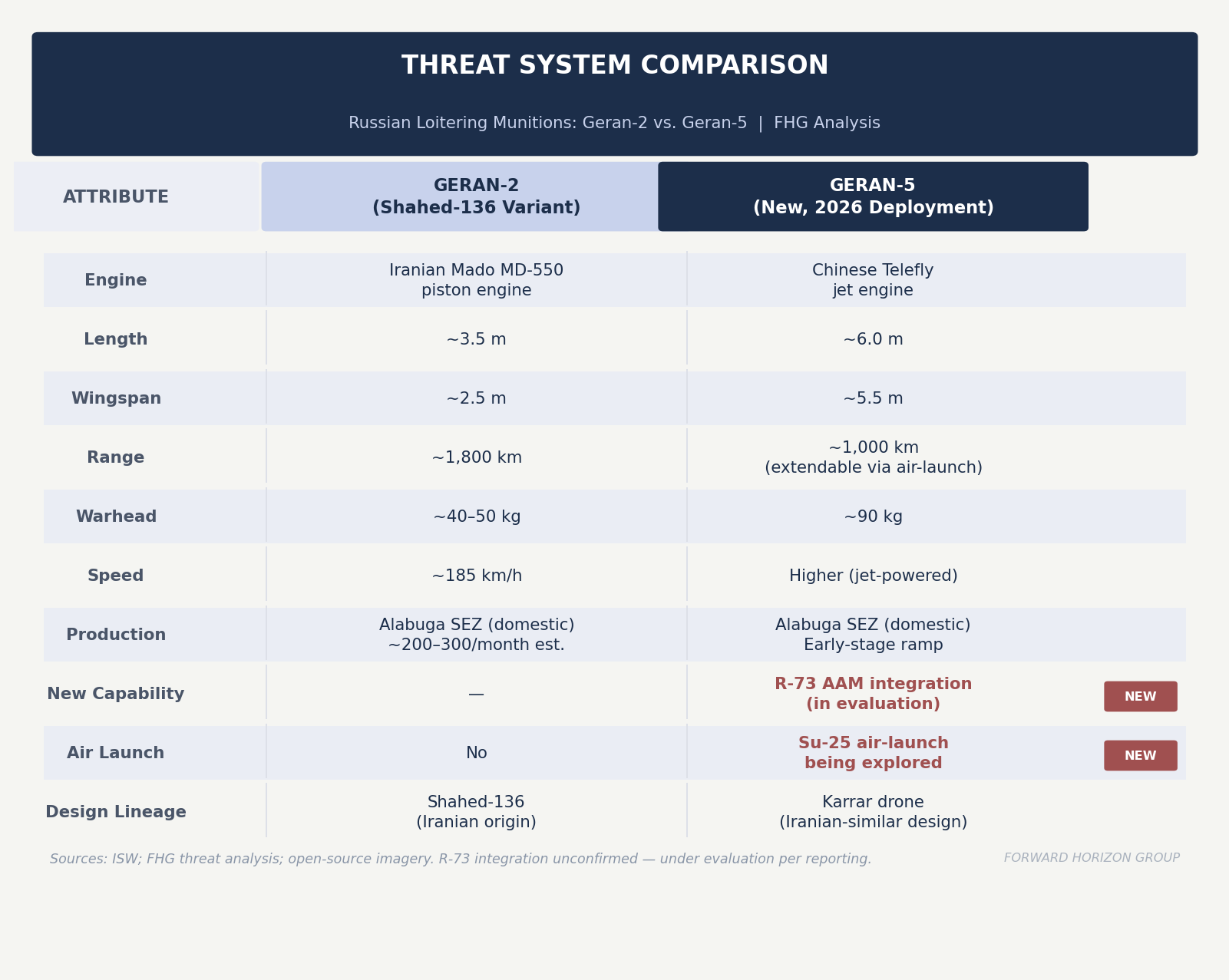
The R-73 integration concept is operationally significant. Ukraine has ramped up interceptor drone production specifically to counter Shahed swarms at range. A platform that can autonomously engage those interceptors mid-flight changes the counter-UAS calculus in contested airspace — and is a direct response to Ukraine’s most effective Shahed mitigation layer.
Russia-Iran tech transfer confirmed in new theater. Zelensky stated on March 7 that Russian components have been identified in Iranian-made drones used in attacks against the United States and countries in the Middle East. Separately, the Iranian drone that attacked a British airbase in Cyprus in early March contained a Russian-made navigation system. This is direct confirmation that the Russia-Iran technology transfer relationship has been bidirectional: Iran supplied drone airframes to Russia, Russia supplied navigation and guidance components back to Iran. Russian EW, navigation, and guidance technology is now being field-tested against US and British targets simultaneously in two theaters.
Ukraine-tested anti-drone systems go to Middle East. The Wall Street Journal reported on March 7 that the US is supplying Ukraine-battlefield-tested anti-drone systems to partners in the Middle East, highlighting growing international demand for Kyiv-proven technology capable of countering Iranian drone attacks. Ukraine also dispatched interceptor drones and a team of drone experts to protect US military bases in Jordan. This is the Ukraine corridor’s value proposition made explicit at the policy level: operational validation in Ukraine is generating direct procurement pull in a second active theater, in real time.
Defense & Procurement Developments
The Ramstein aid architecture from February 12 ($38 billion committed for 2026) remains the structural foundation. The near-term execution risk — German warehouse depletion and 2028–2029 contracted delivery timelines — has not been resolved. Norway’s direct Ukrainian-production purchase model and the PURL mechanism remain the most execution-ready channels.
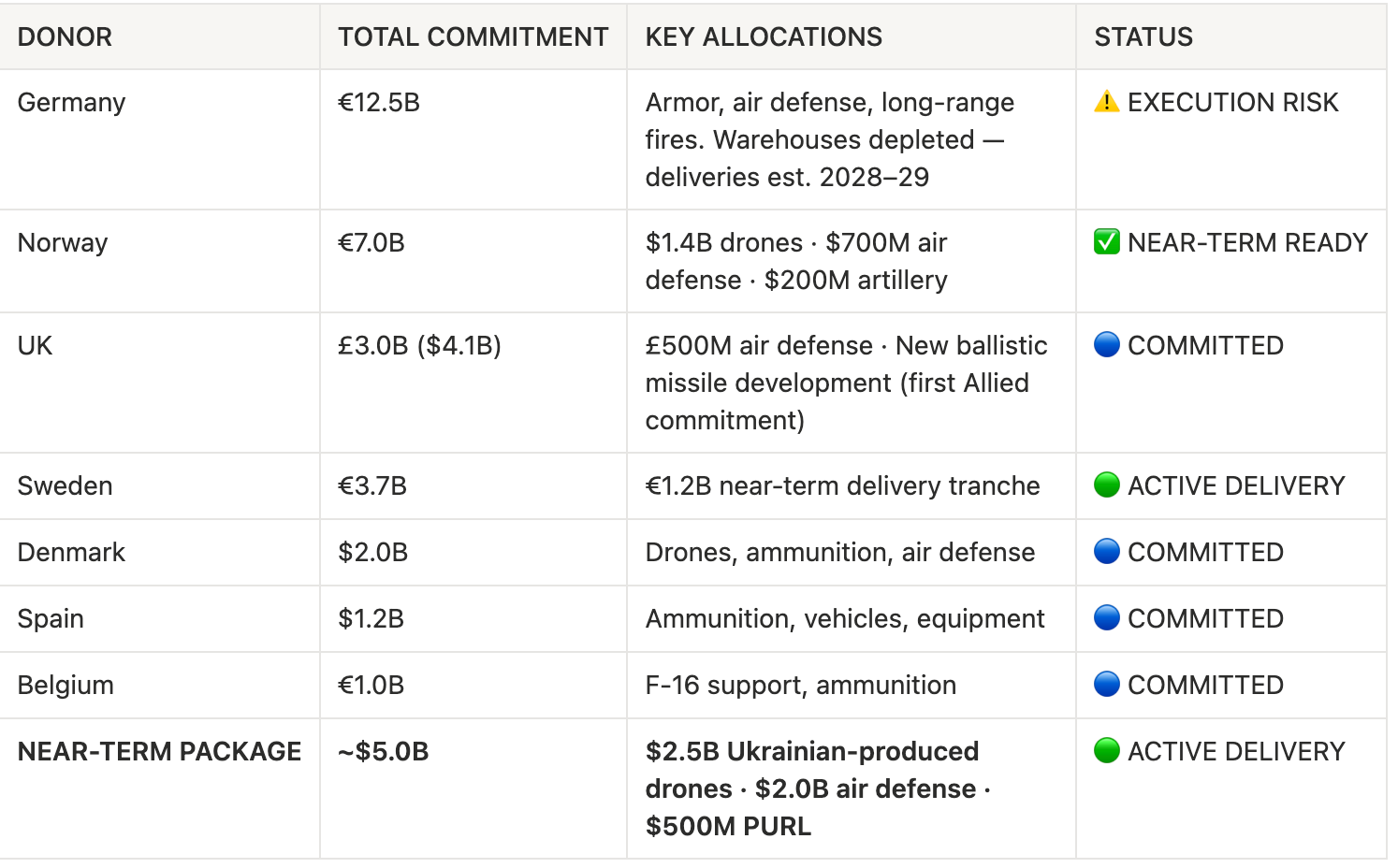
The UK announced it will develop a new ballistic missile for Ukraine’s defense — the first Allied commitment to purpose-build a missile system for Ukrainian defensive requirements rather than drawing down existing stockpiles. Timeline and specifications have not been released publicly.
The accelerating Allied shadow fleet enforcement campaign — two tankers seized in one week — is a meaningful tightening of Russia’s oil revenue channels, which fund the defense industrial base sustaining the current operational tempo.
Diplomatic Picture
Further talks in Geneva are scheduled for early March 2026. The structure remains trilateral US-Ukraine-Russia, with European observers present but excluded from the table. The core territorial impasse has not shifted: Russia demands Ukrainian withdrawal from the approximately 28% of Donetsk Oblast it does not yet control; Ukraine’s position is a freeze at current contact lines.
The US 28-point framework would require Ukraine to cede the portion of Donetsk Oblast Russia has not yet captured — approximately 2,500 square miles — in exchange for a small land swap near Kharkiv of approximately 700 square miles, a net Russian gain of roughly 1,800 square miles. Ukraine has not accepted these terms. The European counterproposal — freeze at the current line of contact — has not gained Russian traction.
Zelensky confirmed that Russia has not responded to the energy ceasefire proposal: “We have not received any response from the Russians. If anything, one could say the opposite — we received responses in the form of drones and missile attacks.”
The Iran conflict is consuming US diplomatic bandwidth. The Geneva March session, if it proceeds, takes place against a backdrop of active US-Israeli military operations, IRGC retaliation across 20-plus US bases, and succession uncertainty in Tehran. The June deadline set by the Trump administration is unchanged, but the attention economy has shifted away from Ukraine in ways that benefit Russian delay tactics.
FHG Assessment: Russia’s negotiating position has materially weakened since the fall — Votkinsk industrial damage, Kapustin Yar degradation, forced VDV redeployment, and its slowest territorial month in nearly two years. But the gap between a weakened Russian position and a Russian position willing to accept territorial compromise remains wide. Ukraine’s June timeline pressure is real. Watch whether the Iran crisis produces a bargaining moment — a US administration eager to close one conflict to focus on another — or simply delays Geneva further into a summer window.
Reconstruction & Economic
The March 7 Kyiv attack knocked out heating in 2,806 residential apartment buildings across four city districts. National grid operator Ukrenergo introduced emergency power cuts in seven regions following the strikes. Ukraine’s generating capacity remains at approximately 14 GW against pre-war capacity of 33.7 GW, with no structural recovery of thermal generation capacity in sight while Russian strikes continue.
In January 2026, Russia’s western border regions such as Belgorod Oblast saw weeks-long outages caused by Ukrainian counter-strikes, with heating at only 50% capacity and around 100,000 customers in Belgorod without running water as of early February. Ukraine’s counterstrike campaign on Russian energy and logistics infrastructure is beginning to impose symmetric cost pressure.
Forward Outlook
Pokrovsk axis — immediate watch. Near Pokrovsk, Ukrainian brigades were withdrawn to support the southern offensive. Russian troops have since stepped up pressure and are advancing toward the city of Dobropillia. This is the most active contested ground in the near term and the axis most likely to generate adverse territorial news in March.
Spring offensive window. ISW’s assessment of a Russian spring thrust toward Slovyansk–Kramatorsk and/or Orikhiv–Zaporizhzhia City retains analytical validity. Ukraine’s February disruption of Russian VDV positioning may have shifted the optimal Russian offensive window later or forced an axis reconsideration. The six-week procurement acceleration window for Ukrainian air defense, counter-armor, and long-range strike replenishment is now.
Geran-5 and countermeasures. If Russia operationally validates the air-launched Geran-5 with R-73 engagement capability, Ukrainian interceptor drones optimized against low-slow Shahed swarms will face a materially harder intercept problem. This is a near-term procurement signal for companies working on counter-drone sensing, autonomous intercept architecture, and hardened communications for DDIL environments.
Ukraine corridor → Middle East procurement pull. The transfer of Ukraine-validated anti-drone technology to Middle East partners is happening now, at speed, driven by US policy. Companies whose systems have been operationally validated in Ukraine have a direct pathway into a second active procurement market. This is the proof-point-to-procurement pipeline FHG has been documenting since 2022, now playing out at the policy level in real time.
UNITE–Brave NATO competition winners are expected at the spring NATO-Ukraine Defence Innovators Forum. Results will signal which technology categories NATO is prepared to accelerate from the innovation pipeline into procurement — a leading indicator of where Allied rapid acquisition spending concentrates in late 2026.